AI Training Jobs in Africa: Skills You Need and Where to Start
 Mboka LegitNovember 18, 20266 Mins read
A few years ago, if you told someone you could work for an AI company from your bedroom in Nairobi, Lagos, Accra or Kampala, they would have laughed. Today, it is a real thing that thousands of Africans do. It is not easy money, and it is not for everyone, but it is real work with real companies behind it.
If you have been searching for AI training jobs in Africa, this guide will walk you through what the work actually is, who can do it, the skills that get you approved, where to look, and the mistakes that get most beginners rejected. No hype, just what you need to know before you start.
What Are AI Training Jobs?
AI models like chatbots, image generators and voice assistants don’t learn on their own. Humans teach them. AI training jobs are the tasks people do to help those systems get smarter and safer.
In practice, the work usually looks like one of these:
- Data annotation: labelling images, text, audio or video so a model can learn what it is looking at. For example, marking every car in a street photo.
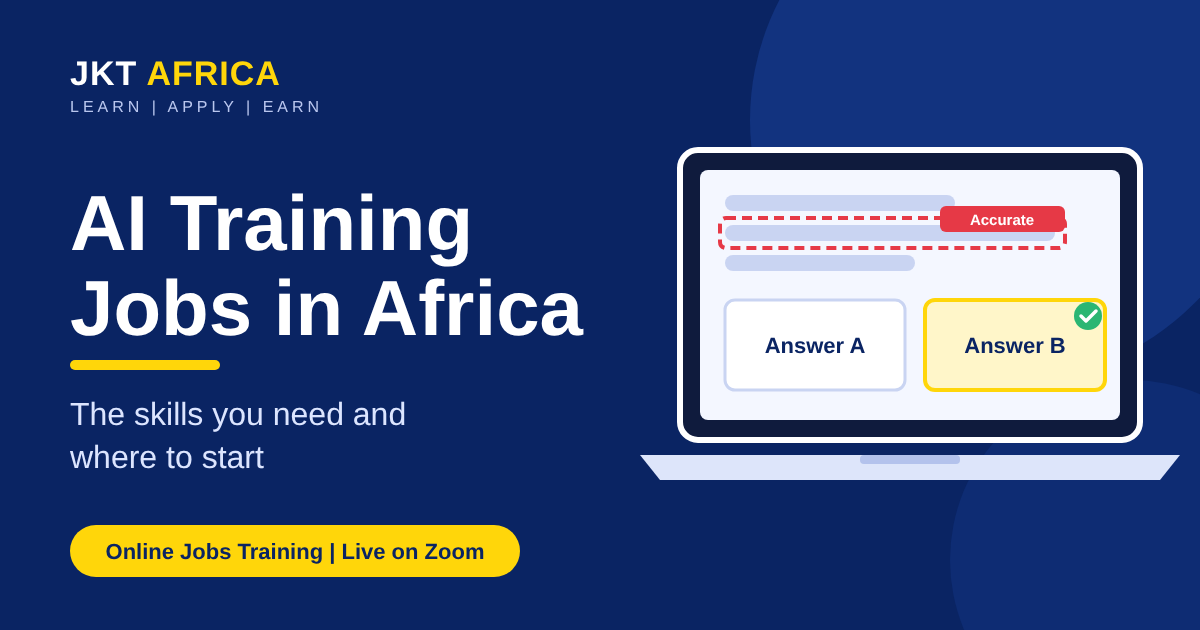
- Rating and ranking AI responses: reading two or three answers from a chatbot and deciding which one is more accurate, helpful or safe.
- Writing and reviewing prompts and answers: creating questions for AI to answer, or checking whether its answers are correct.
- Transcription: turning audio into accurate written text, often with specific formatting rules.
- Translation and language work: especially valuable for African languages like Swahili, Yoruba, Hausa, Amharic and Zulu, which AI still handles poorly.
- Subject-matter review: experts in maths, coding, law, medicine, finance or science checking whether AI gets technical answers right.
Some people call this “data annotation work”, others say “AI tutoring” or “AI evaluation”. The names differ by company, but the idea is the same: a human checks, corrects or guides the machine.
Why Africa Is Part of This Story
AI companies need huge numbers of people who can read, think carefully and follow instructions. Africa has a young, English-speaking and increasingly online workforce, plus languages and cultural knowledge that global AI systems often get wrong. That makes African workers genuinely useful, not just cheap labour.
That said, this is an area that changes quickly. Platforms open and close projects, change which countries they accept, and update their pay and rules. Treat any article, including this one, as a starting point and always check the platform’s own website for the latest requirements.
Skills You Need to Get Started
The good news is that you do not need to be a programmer for most entry-level AI training work. Here is what actually matters.
1. Strong reading and writing in English
Most tasks come with long instructions and you will be judged on your ability to understand them. Clear, correct writing matters, especially for rating and writing tasks.
2. Attention to detail
This is the number one reason people pass or fail. Missing one rule in a 10-page guideline can cost you a task, or your account. If you are the kind of person who double-checks everything, you have an advantage.
3. Critical thinking
You will often be asked to decide which answer is better and explain why. That means spotting errors, weak logic, bias or made-up facts.
4. Basic computer and internet skills
You need to be comfortable with a laptop, browser, spreadsheets and uploading files. A stable internet connection and a reliable laptop are non-negotiable.
5. Self-discipline
No one is watching you. Projects come with deadlines and quality checks, so you need to manage your own time.
6. A specialty (this is where you stand out)
People with a specific skill tend to get better opportunities. That could be:
- Coding or software development
- Maths, physics, chemistry or biology
- Law, finance or accounting
- Teaching or academic writing
- Fluency in a local language
- Creative writing or editing
If you are a student or graduate, your field of study may be worth more than you realise.
Where to Start: Platforms to Know
Here are platforms commonly mentioned by people working in this space. Availability depends on your country and on current demand, so always verify on the official site.
- Outlier: AI training and evaluation projects, often with assessments by subject.
- Remotasks: task-based data work. Check current availability in your country before investing time.
- Handshake AI: projects for students and graduates with subject knowledge.
- Mindrift: AI tutoring and evaluation tasks for people with expertise.
- DataAnnotation: assessment-based entry into rating and writing work.
- Prolific: paid research studies and surveys, which often include AI-related tasks.
- Toloka, Appen, TELUS Digital and similar companies: larger data companies that run projects from time to time.
A quick tip: do not sign up for ten platforms in one afternoon. Pick two or three, do them properly, and learn how their assessments work.
How to Apply Step by Step
- Prepare a clean CV. Keep it to one or two pages. Highlight education, skills, languages and any experience involving writing, research, data or tech.
- Create your profile honestly. Use your real name, real details and your real location. Platforms verify identity and mismatches are one of the most common reasons for bans.
- Read every instruction before you start. Most beginners rush and fail. Take your time.
- Take the assessment seriously. Treat it like a job interview. Work in a quiet place, with a good connection, and do not copy answers from AI tools or other people. Platforms look for that.
- Be patient after applying. Some people get a response within days, others hear nothing for weeks. Keep applying to other platforms and improving your skills while you wait.
- Start small once approved. Focus on quality first. Your accuracy score often decides whether you keep getting work.
Mistakes That Get Beginners Rejected
- Using someone else’s identity, a fake location or a borrowed account. This breaks platform rules and can get you permanently banned.
- Rushing through assessments without reading instructions.
- Submitting AI-generated answers when the task asks for your own thinking.
- Applying with a messy CV full of typos.
- Giving up after one rejection. Many successful workers were rejected the first time and improved before trying again.
How to Spot an AI Job Scam
Because this niche is popular, scammers love it. Watch out for:
- Anyone asking you to pay a fee to “unlock” a job or get approved. Real platforms do not charge you to work.
- Promises of guaranteed income, such as “earn $500 a week for sure”.
- Pressure to hurry, or to send your ID and bank details over WhatsApp.
- Offers to sell you accounts or help you “bypass verification”.
- No company website, no clear contact details, no real reviews.
When in doubt, go to the platform’s official website directly and apply there, not through a link someone sent you.
What About Pay?
Pay varies widely depending on the platform, the type of task, your expertise and how consistent the work is. Specialised work such as coding or medical review generally pays more than basic labelling. Work can also be irregular, with busy periods and quiet ones. So think of AI training as a flexible side income or a stepping stone, rather than a guaranteed salary, especially when you are just starting. Be honest with yourself about this and plan accordingly.
How to Get Ready Before You Apply
If you want to improve your chances, spend a week or two on preparation:
- Practise reading and following long instructions.
- Improve your typing speed and accuracy.
- Brush up on grammar and editing.
- Sharpen the subject you know best.
- Build a professional CV and a clear online profile.
- Set up a quiet workspace and test your internet.
This is the part many people skip, and it is where good training makes a difference.
Frequently Asked Questions
Can I get AI training jobs in Africa without a degree?
Sometimes, yes. Some tasks value skills and test results more than certificates. However, specialised projects often prefer degrees or proven expertise.
Which countries in Africa can apply?
It depends on the platform and changes over time. Kenya, Nigeria, South Africa, Ghana and others are often included, but always check the current list on each platform’s site.
Do I need a powerful laptop?
No. A reliable laptop with a modern browser and stable internet is enough for most tasks.
How long does it take to get approved?
Anywhere from a few days to a few weeks, and some applications never get a response. Applying to several platforms helps.
Is it a full-time job?
For most people it starts as part-time or freelance work. Some build it into more steady income over time, but there are no guarantees.
Is AI going to replace these jobs?
The work is changing as AI improves, with more demand for expert reviewers and fewer simple tasks. That is exactly why building real skills matters more than ever.
Final Thoughts
AI training jobs in Africa are a genuine opportunity for people who are patient, careful and willing to learn. They are not a get-rich-quick scheme, and they are not for people looking for shortcuts. But if you prepare properly, apply honestly and focus on quality, they can open the door to flexible remote work and valuable digital skills.
Want Guided Help Getting Started?
At JKT Africa, our Online Jobs Training walks you through finding real online jobs, building a strong CV and profile, applying step by step, and preparing for assessments, with live Q&A and practical demonstrations on Zoom. You also get bonuses like CV and application templates, a list of trusted job platforms and access to our support group.
Classes run Monday to Friday, 8:30 PM to 10:00 PM (EAT), live on Zoom. Slots are limited.
WhatsApp to register: 0741 745 675




Related Articles

Get Paid to Train AI From Home: A Complete Guide for Africa and Beyond
Artificial intelligence is changing how people work, learn, communicate, shop, and access...

AI Training Jobs in 2026: How to Get Started and Earn Money Online
Artificial Intelligence (AI) is transforming industries around the world, creating thousands of...


Atlas Capture Review (2026): How to Get Paid for Recording Simple Videos and Data Annotation Jobs
If you’re looking for a legitimate way to earn money online, Atlas...

Leave a comment